
Welcome to The NVI Deep Dive, a new blog series designed to explore the data behind the Neighborhood Vitality Index. While the data we provide through the NVI website is one lens into this information, the NVI’s wealth of responses also allows us to take a much deeper look at factors that affect Detroiters’ lives than we’ve been able to do in the past. In each post, we’ll identify trends and connections that can inform how you engage with your neighborhood. Today’s blog looks at the relationship between residents’ willingness to report crime and other characteristics and experiences of these respondents. For example, are people who are new to their neighborhood more likely to report crime...or less? Let’s take a closer look at what the data reveals.
Crime is an issue for many large cities, including Detroit, but official crime statistics often only tell part of the story, as many incidents may not be reported and/or recorded at all. Since we know that this is the case, the NVI survey asks why people might hesitate or avoid reporting a crime.
The 2024 NVI survey asked:
“Would any of the reasons below cause you to hesitate or avoid reporting crime? Select all that apply.
| Reason for hesitation | 2024 Responses |
|---|---|
| General distrust | 19% |
| Concern | 30% |
| Fear | 24% |
| Risk | 3% |
| Other | 5% |
| Wouldn't hesitate | 51% |
These do not total 100% because respondents could select more than one option
Of those Detroit residents who responded that they would hesitate or avoid reporting a crime, the greatest proportion were concerned that they would not be taken seriously or no action would be taken, followed by fear of retaliation. Respondents frequently selected these two reasons together.
Over the last year we’ve spent a lot of time reviewing the NVI data with people across Detroit, and many residents have asked us whether there is a relationship between a hesitancy to report crime and the crime rate. When we explore the relationship between crime rates, both violent and property, for the seven council districts in Detroit and the percentage of respondents hesitating to report crime (Figures 1 and 2), we observe that there is a possible weak relationship for both violent (Figure 1) and property crimes (Figure 2). Higher rates of violent crime seem to be associated with lower hesitancy to report crimes, while higher rates of property crime seem to be associated with slightly higher hesitancy.
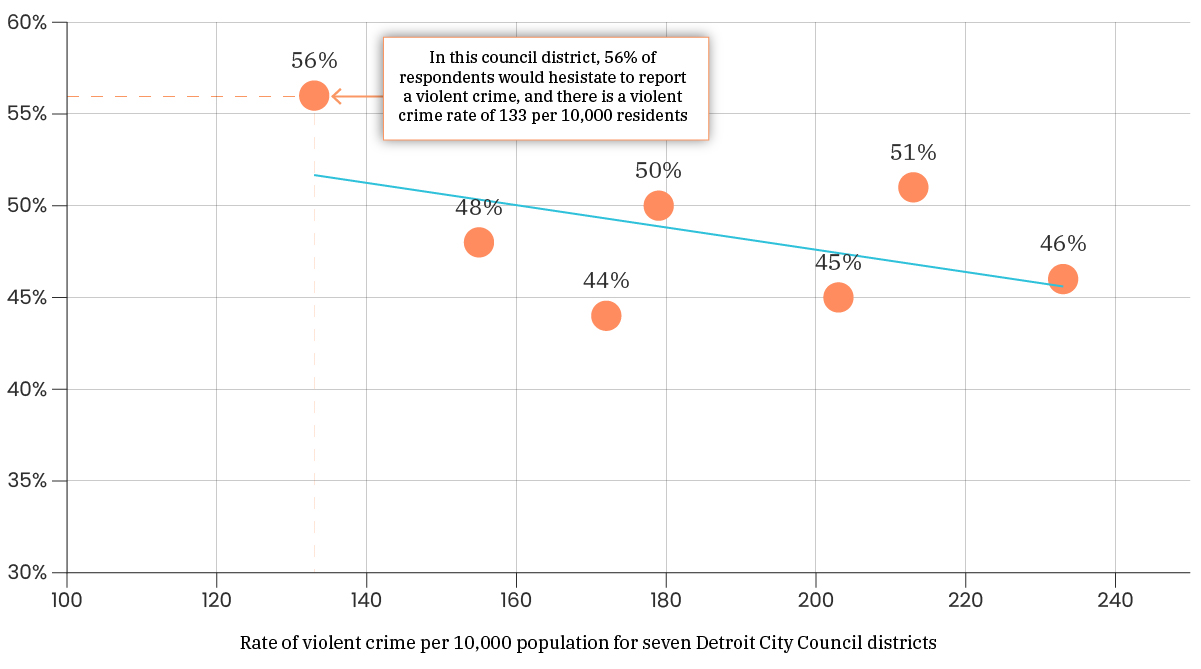
Note that the charts do not begin at 0.
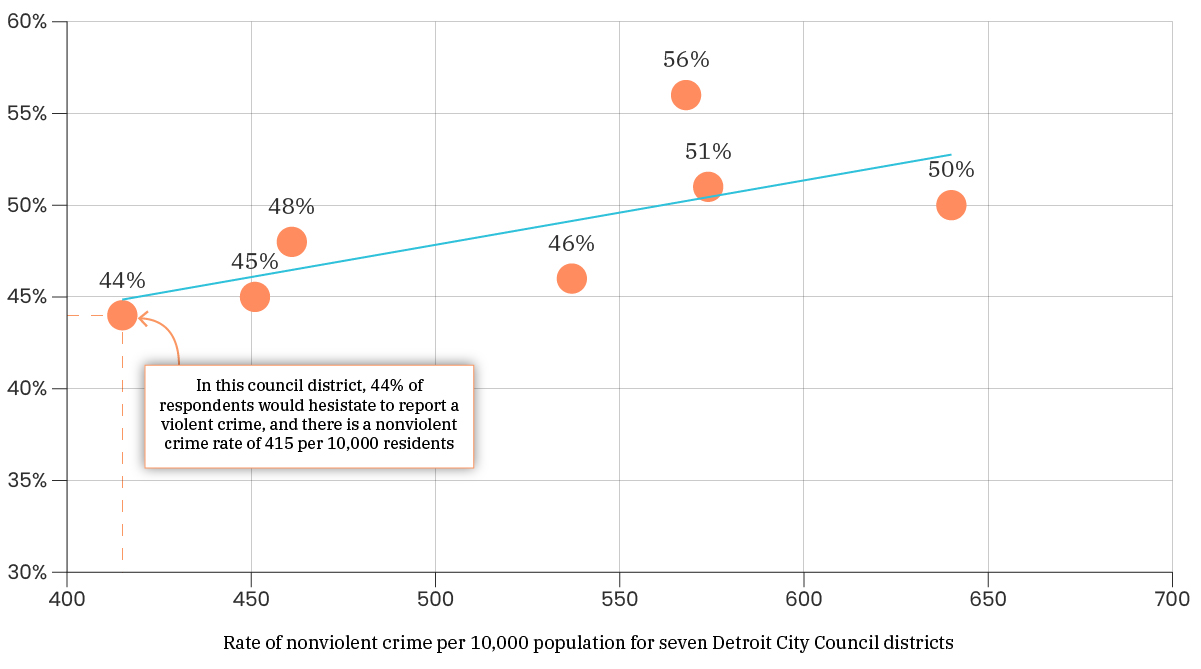
Note that the charts do not begin at 0.
Since we don’t see a strong correlation in either case, this presents an opportunity to continue conversations about other factors in a neighborhood that might impact a resident’s willingness to report a crime. The rest of this post has some analysis of other NVI data to support those conversations.
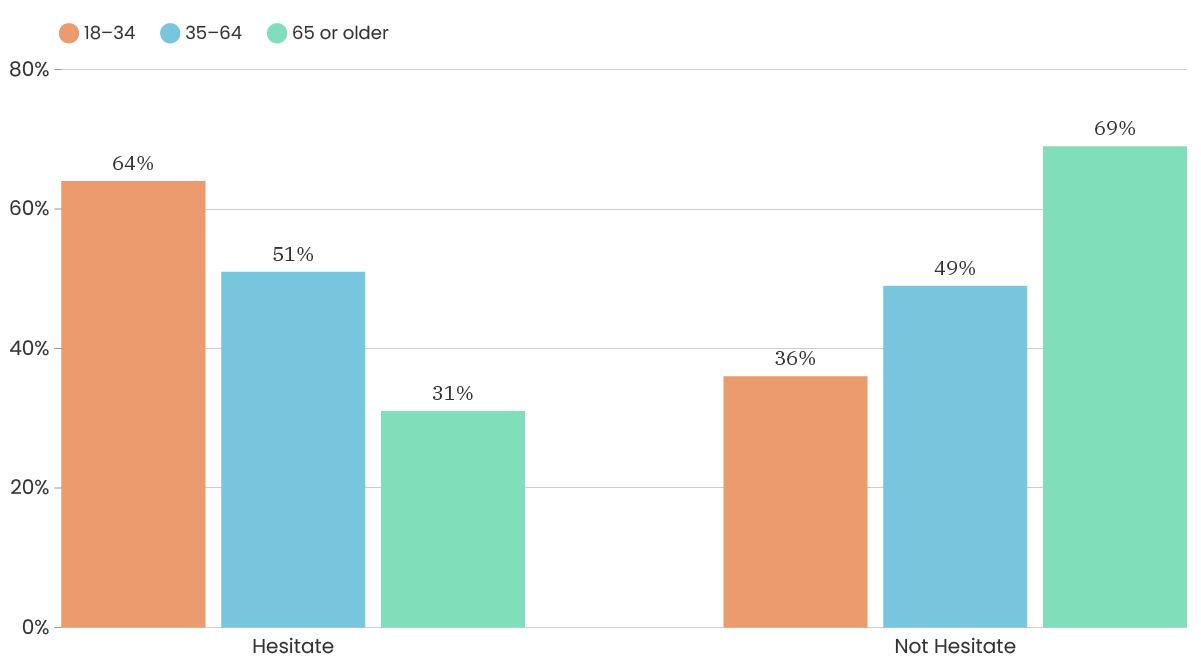
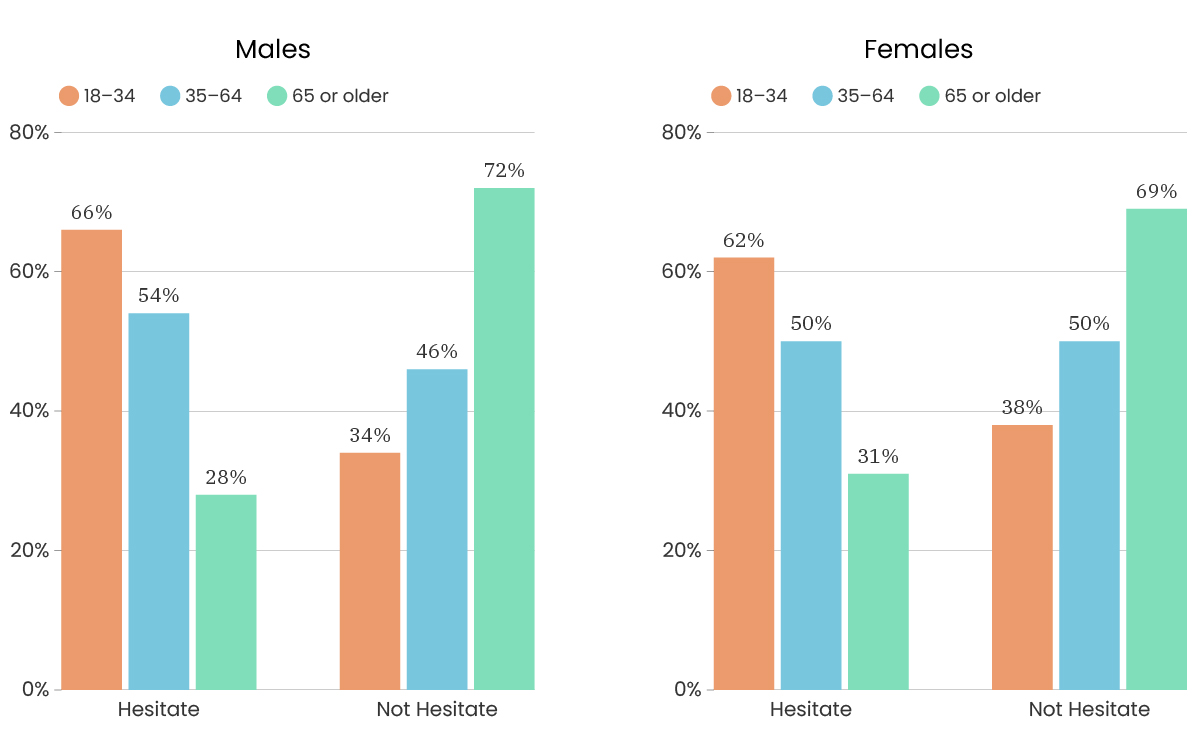
While we investigated gender and income as potential differentiating factors, neither seemed to have a substantial relationship to a respondent’s likelihood to report a crime. By far, the characteristic that most differentiated hesitation to report crime was the age of the respondent. Here age is divided into three groups: 18-34, 35-64, and 65 or older. While the percentages should be interpreted with some caution due to the sampling process (see the introductory note or our in-depth blog about representativeness), the youngest group seemed about twice as likely as the oldest group to avoid or be hesitant to report a crime.
When we look at gender and age together, some of the trends still hold. Younger males, ages 18-34 and 35-64, remained somewhat more reluctant than comparably-aged females to report a crime. This appeared to not be true for the oldest age group.
We have considered the impact of personal characteristics such as age and income on likelihood of reporting a crime, but the NVI also looks to understand neighborhoods and the overall experiences of their residents. One of the overarching factors we seek to measure is social cohesion: the sense of belonging in a neighborhood, feeling supported and well-connected with those around you. With the NVI data, we can explore how those experiences might influence a person’s willingness to report crime.
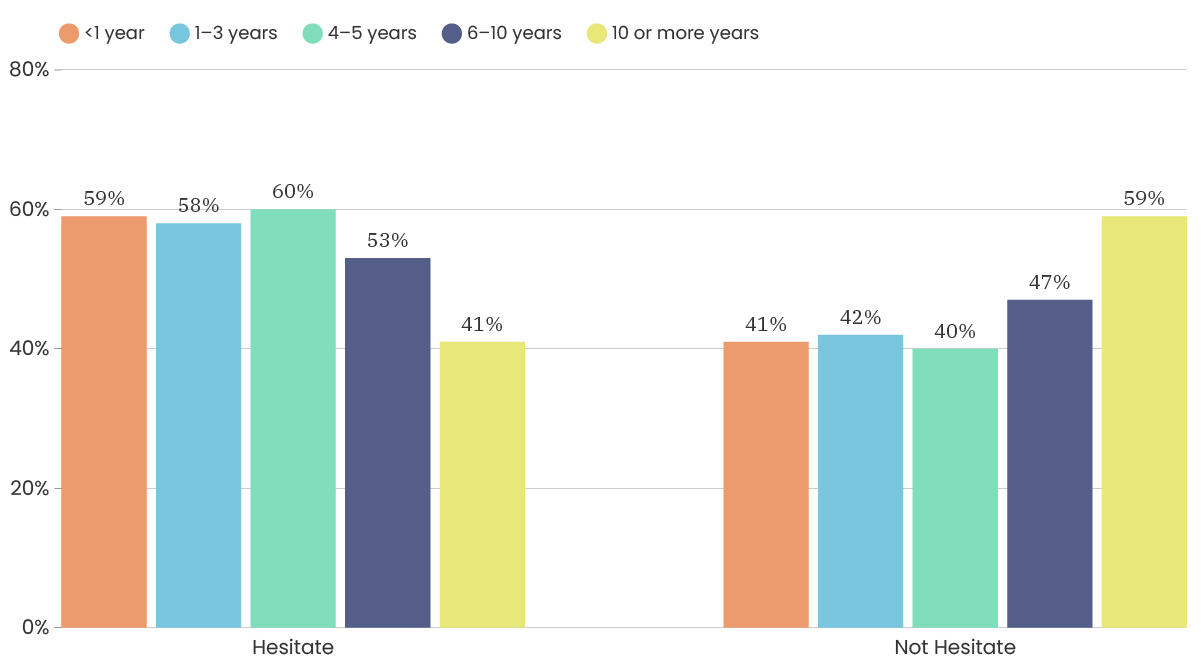
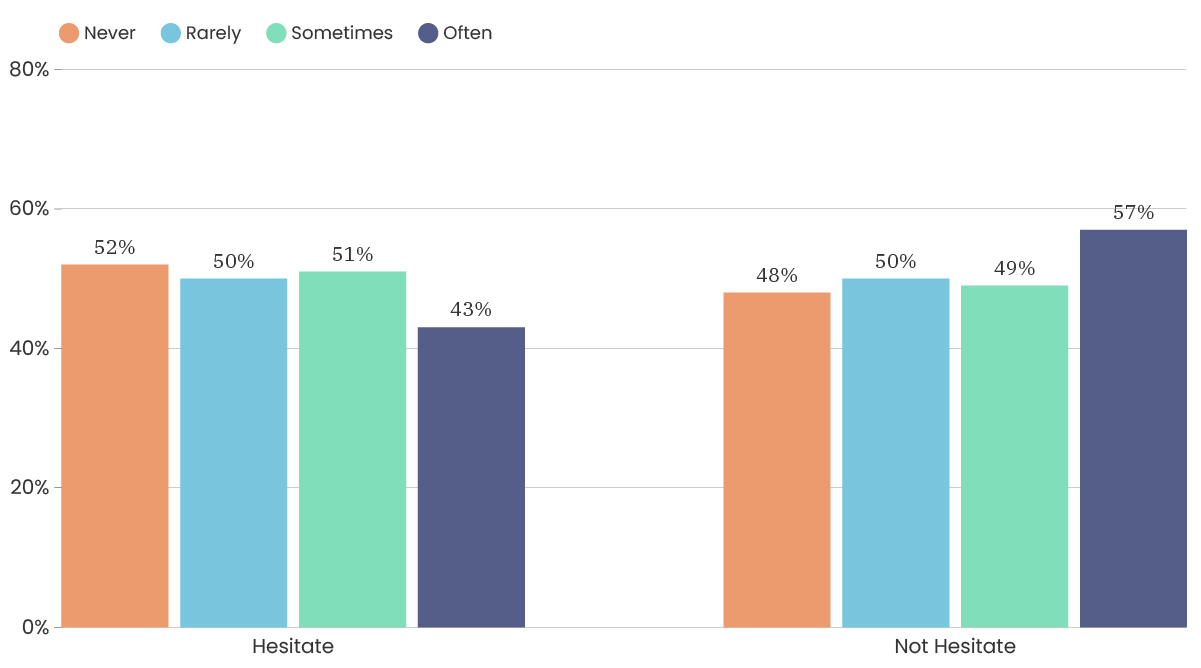
Many aspects of NVI look at a resident’s experiences within their community, such as their access to amenities and their participation in neighborhood or community groups. Through investigating relationships between these questions, it appears that connection with community, through participation and longevity of residence, is associated with being more comfortable reporting crime.
Residents who lived in their current residence for 6-10 years and especially for 10 or more years were much more likely to not hesitate or avoid reporting a crime.
Similarly, residents who participate often in their neighborhood groups are more likely to feel comfortable with reporting crime.
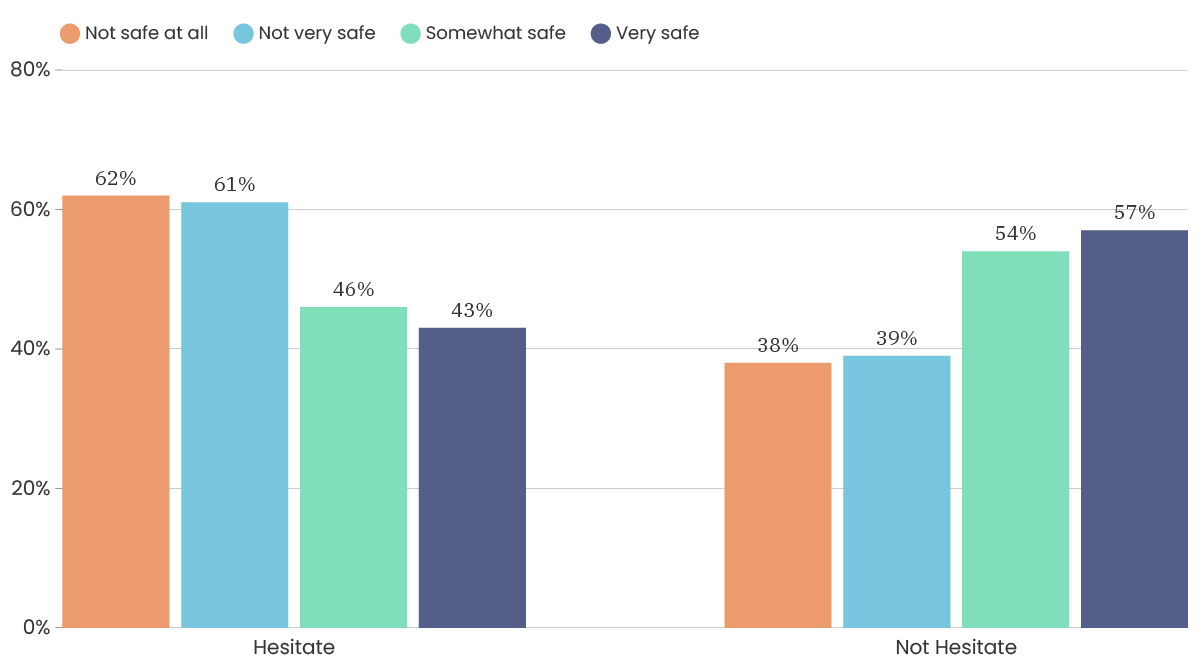
Residents who feel safe in their neighborhood are also less likely to hesitate reporting crime. This was also true of feelings of safety in public spaces, with the percentages (not shown) nearly the same as with neighborhood safety.
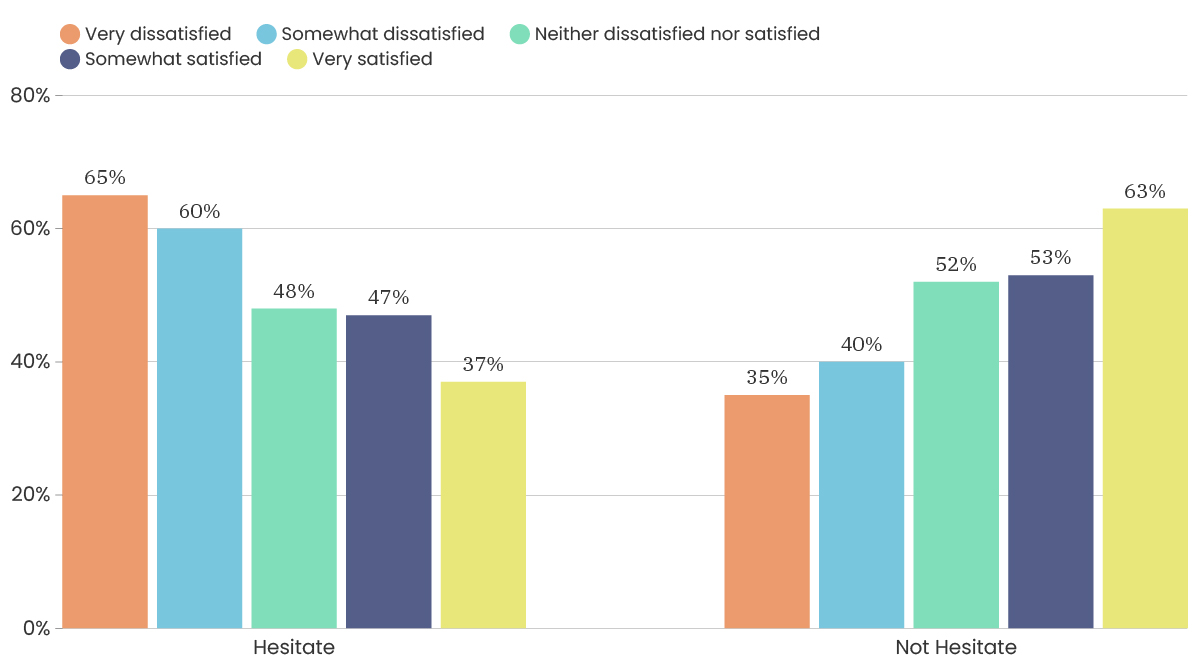
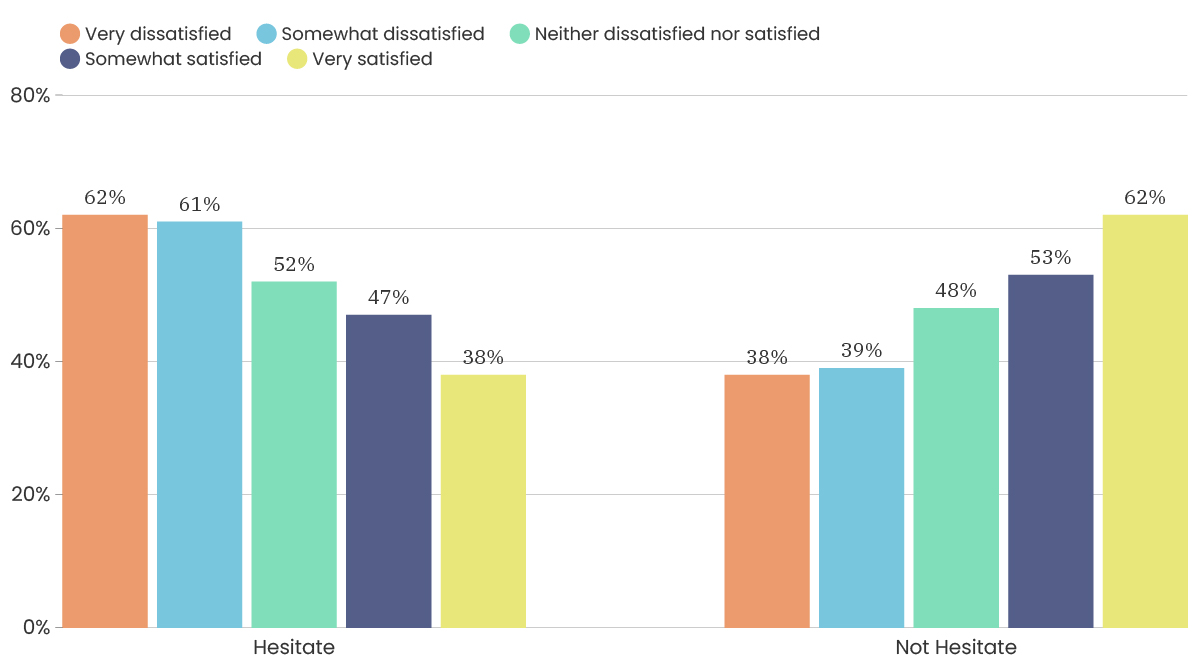
We can also dig deeper and see how people who are satisfied with various amenities in their neighborhood experience crime. In keeping with the idea that amenities can help promote social cohesion in a neighborhood, we found that satisfaction with access to medical care and neighborhood parks and playgrounds were both associated with an increased likelihood of reporting crime.
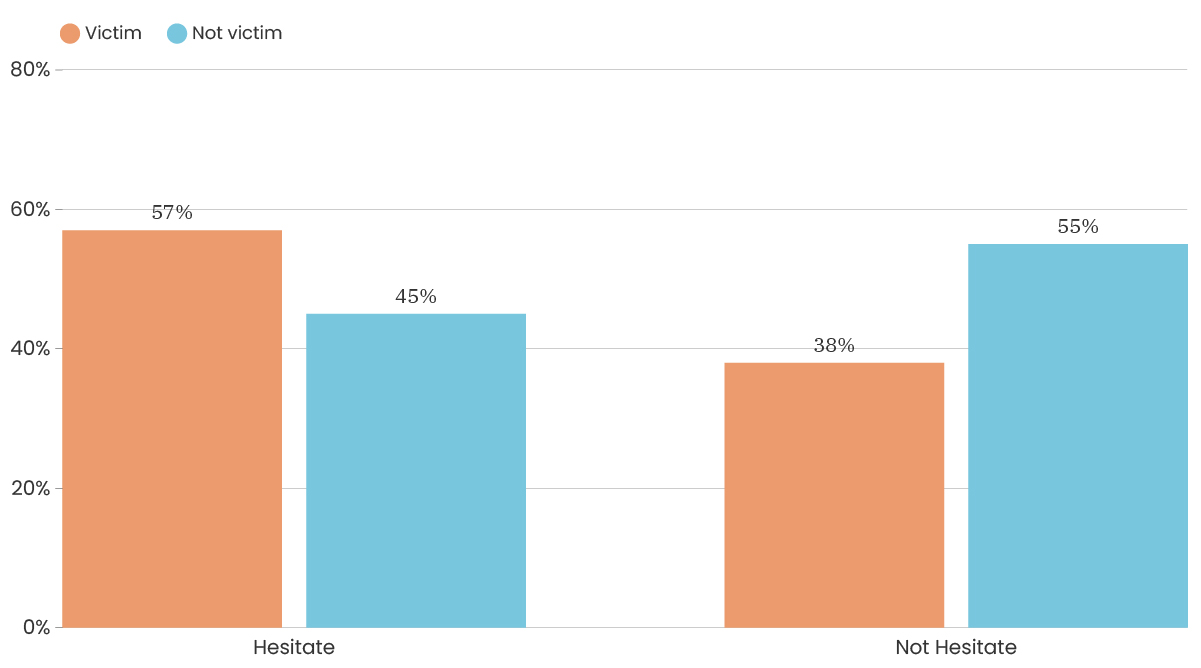
Finally, the NVI survey also asked residents about their prior experiences with the carceral system. For respondents who answered “yes” to “Do you have a family member who is or has been incarcerated in the last 3 years,” we observed a somewhat higher amount of hesitancy before reporting a crime. Interestingly, this violation of social cohesion and safety seems to be associated with increased hesitation to report crimes, which suggests the potential for more deeply exploring these residents’ experiences with the carceral system itself.
This analysis began with the observation that not all crimes are reported to the authorities, and thus, the crime data available through conventional sources is likely underreported. This led us to wonder who is more likely to hesitate or avoid reporting crime? Using the NVI data, this analysis provides some clues, and helps to surface other questions. Why do younger residents hesitate more to report crime? Why is that also true for people who have connections with the carceral system? And if social cohesion appears to help increase residents’ willingness to report crime, what can we do to support these conditions across Detroit, including with younger Detroiters and those who have experienced incarceration?
UThese questions may be beyond the purview of the NVI data itself, but these findings – and the data underpinning them – can serve as starting points for deeper conversations with residents. By grounding community work in what we’re hearing from Detroiters through the NVI survey, we can more quickly cut to the heart of a question, creating solutions and conversations that directly address the underlying causes of challenges that residents may experience.
NVI data is collected from residents who opt to take the survey. Based on our analysis of respondents, we know that the 2024 survey collected responses from more females and more older residents than the Census Bureau estimates in the city. However, the voices of Detroit residents deserve to be heard and these are the people who were willing to share their stories last year. If you want to learn more about the representativeness of the NVI survey, please visit our demographics blog post where we explore this in detail.